
BEST Dental Implants Near You
Partial and Full Mouth Dental Implants in Stratford, CT
Looking for Affordable Dental Implants Near Stratford, CT?
Hawley Lane Dental is a dedicated provider of affordable dental implants near you in Stratford, CT, Trumbull, and Bridgeport. Losing a tooth is devastating, but with the invention of dental implants, tooth loss can be as temporary as the simplest of cavities.
Dental Implants are a great alternative to traditional bridges or dentures when replacing missing teeth. Unlike bridgework or dentures, which can affect the adjacent teeth over time, teeth implants are freestanding and, as a result, may not lead to problems with your other teeth.
Click to find out more:
Are You a Candidate?
What Are Dental Implants?
Dental implants may be used to permanently anchor crowns … Click to open this link in the same window … , dental bridges … Click to open this link in the same window … , or dentures … Click to open this link in the same window … for damaged teeth. When used for crowns or bridges, they consist of three parts: the body (single or multiple), the abutment(s), and the crown or bridge. The implant body is commonly referred to as the “implant.” It is a metal (usually titanium) post that is placed below the level of the gum into the bone. The abutment is then attached to the implant to be visible above the gum; it is what holds the crown in place. The crown is then cemented onto the abutment.
The most common type of implant is used to replace a single tooth, although people can have multiple teeth replaced and even get full-mouth dental implants for a certain cost. Most patients who choose implants do so because they do not wish to have their natural teeth cut down for a fixed bridge. The implant allows them to replace their missing tooth while saving their own surrounding teeth.
How Much Do Dental Implants Cost?
Are Dental Implants Affordable?
Although the initial cost of a dental implant in Connecticut may be higher than other treatments like bridges and dentures, many patients in Stratford, CT choose dental implants so they won’t have to worry about the long-term replacement cost. Tooth-supported bridges and dentures need to be replaced over time due to wear and loss of integrity. When cared for properly, dental implants should not have to be replaced.
While dental implants in CT may be a larger investment of time and money, the long-term benefits usually outweigh the initial cost of dental implant treatment. When it comes to treating serious dental problems dental implants often end up being the more affordable option rather than repeated treatments for unhealthy teeth. We know that the dental implant cost in CT may be a deterrent for some moving forward with replacing missing teeth, but it doesn’t have to be.
What Is The Cost of Dental Implants in CT?
The cost of dental procedures is a significant consideration for many individuals, especially when it comes to dental implants. One of the top questions that dental professionals frequently hear is, “Are dental implants affordable?” and specifically, “What is the cost of dental implants in Connecticut?”. The average cost for dental implants in CT, factoring in various factors, typically falls in the range between $2,500 to $8,000 per tooth. This estimation pertains primarily to the cost of the implant itself, which is often referenced as the “single tooth implant cost” or “tooth implant cost”.
However, like many medical expenses, this price isn’t absolute. Several variables can affect the overall cost of implant procedures. The intricacy of the procedure, the materials used, and the additional treatments required can all influence the final expense. For instance, if a patient needs porcelain crowns, especially for their front teeth, they might find themselves paying more than the cost for other teeth. Additionally, if a patient has unfortunately lost a tooth and requires oral surgery to embed the screw to which the implant attaches, there’s an added cost to that surgical procedure. While the average cost of a dental implant provides a ballpark figure, the exact tooth implant cost in Connecticut will largely depend on a patient’s unique dental scenario.
Our implant dentist, Dr. Kristy Gretzula… Click to open this link in the same window …, is a member of the American Dental Association… Click to open this link in a new window … and Academy of General Dentistry. She is continually voted “Top Dentist” by Westport Magazine… Click to open this link in a new window …, reflecting her skill and experience in both patient and dental care. The team here at Hawley Lane Dental is happy to offer affordable dental implant options in CT to our patients at a reasonable cost.
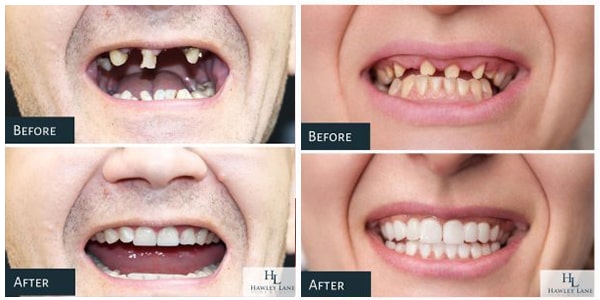
Dental Implants: Before and After Results
Dental implants are a fantastic way to improve the look and feel of one’s teeth. They can give you back a beautiful smile as well as make it much easier to eat and chew. The results of dental implants can be quite dramatic. These before and after pictures of dental implant patients help to show how effective dental implants can be.
FAQ for Dental Implants
Our Stratford dentists answer your questions.
We believe you should understand everything about your health. So that’s why we’re providing everything you may want to know before you start recovering your smile.
-
Am I a Candidate for Dental Implants?
People lose teeth for a variety of reasons including gum disease, fracture, abscess, facial trauma, or cavities. If you have a missing tooth, today there are many options to choose from to help improve your smile. Fixed dental bridges … Click to open this link in the same window … , removable dentures … Click to open this link in the same window … , or dental implants … Click to open this link in the same window … may be chosen to replace missing teeth. Each one of these options has its pros and cons.
-
How Does a Dental Implant Work?
Dental implants are the most permanent and aesthetic option for patients looking to replace teeth that have been lost due to decay, infection, periodontal disease … Click to open this link in the same window … , or trauma, and are often chosen for their longevity and aesthetics. Typically made of titanium, which is medical grade and similar to the metal used in joint replacements, implants are placed subgingivally (below the gum) and into the bone. They mimic the root of a tooth.
Over time (usually 4-6 months), the bone of the jaw grows around the implants and locks the implants into place. This process is called osseointegration. Following successful osseointegration, the implants are ready to be restored, and a supporting crown … Click to open this link in the same window … or denture … Click to open this link in the same window … is placed on top of the implant. The patient is then able to function like they would with a natural tooth.
-
Who Can Get Dental Implants?
- Patients missing one or more of their natural teeth
- In good general health
- Patients unhappy with the fit or look of partial dentures or full dentures
- Have a good supporting bone
Although good general health is very helpful to the success of a dental implant, patients with health conditions can still be good candidates. Those with diabetes, certain heart conditions, or high blood pressure should alert their dentist to their health condition so that their overall general health can be closely monitored.
It is important to note that dental implants are designed for people who are missing a tooth or who have a tooth that needs to be removed due to trauma or decay. Dentists will try to save a natural tooth if possible before moving to the step of a dental implant. If a patient has a tooth that has broken or is damaged in some other way but it can be saved, the ideal option would be a dental crown … Click to open this link in the same window … instead of an implant. It is always best to speak with an experienced dentist near you … Click to open this link in the same window … about all of your options when looking for tooth replacement.
-
What Is the Success Rate of a Dental Implant?
Dental implants have a very high success rate (close to 98%) if they are placed in proper conditions and in the right patient. Certain conditions can exclude dental implants as a choice or cause them to be unsuccessful, such as:
- Thin jaws that cannot take a bone graph
- Smoking – According to a study done in the Journal of Periodontology … Click to open this link in new window … (JOP), smokers have a greater risk of infection and tend to heal more slowly.
- Children – Since the jaw bone is still growing, dental implants are usually delayed until adulthood.
- Health – Certain medical conditions or medications may prevent implant healing
-
What If I Have Bone Loss?
Over time, in areas where teeth are missing, the bone is naturally resorbed by the body. It becomes shorter and thinner. If a patient desires an implant and has been missing a tooth or teeth for several years, the bone has most likely already begun to resorb, and the area may require the placement of additional bone. Bone grafting may be placed prior to an implant to ensure that the bone is thick enough and strong enough to successfully support an implant.
Patients with certain medical conditions, such as uncontrolled diabetes or osteoporosis … Click to open this link in a new window … , may not be able to have dental implants. Additionally, smokers may have a greater chance of implant failure or delayed healing.
Dental Implant Procedure
A guide from a trusted dentist near you.

Once a patient has made the decision to have dental implants and is determined to be a good candidate, a dental team will work together to ensure the best outcome is obtained.
Treatment planning and record-taking are essential steps to allow seamless surgery and restoration. X-rays and cone beam (CT), models, wax-ups, and surgical stents may be utilized as well.
Oral Surgeons, Periodontists, and some General Dentists may perform the implant surgery, placing the implants into the bone. Most patients tolerate surgery well.
The surgery begins with anesthesia and then the implant is drilled into the bone and tightened. Sutures are placed to cover the implant with the gum. Sometimes a temporary tooth is placed with a denture or temporary crown.
When healing is successful and complete (usually 4-6 months), a second minor surgery is necessary to expose the implant. A minor incision is created and a healing cap is placed on the implant. The gum is closed around the cap but leaves the cap exposed. Once this has healed (usually in a couple of weeks), a Prosthodontist or General Dentist will continue the process and provide the final prosthesis.
In a typical single implant case, the implant is restored in two possible ways:
- Cement-retained – a part called an abutment is screwed to the implant. It sticks out of the gum and a crown/tooth is cemented to the abutment
- Screw-retained – a crown is screwed directly to the implant, eliminating the cement.
Depending on the case and the doctor’s preference, the dentist may choose either one of these options. Both cement and screw-retained implants are designed to give the patient many years of use of their new tooth. Although dental implants cannot get cavities, they are susceptible to infection and gum disease. Proper home care is necessary to ensure the gum and bone around the implants remain healthy.
Patients with implants should brush and floss around their implants and see their dentist regularly for maintenance and observation. The dentist or hygienist will clean around the implants, measure that the gum is still tight and no infection is present, and ensure that all parts are working properly. If you are looking for affordable dental implants in CT talk to our office today about setting up a consultation appointment.
Types of Dental Implants
Fortunately, there are several tooth implant restoration options to maintain a healthy, functioning smile
Dental implants may be used in many ways, from replacing a single tooth to full mouth rehabilitation:


Both dentures and dental implants ultimately serve the same purpose, to replace one or more missing teeth.
Denture implants – Sometimes called overdentures or implant-supported dentures – are a newer, more stable version of traditional dentures that have become more popular in recent years.
Conventional dentures rest solely on the gum tissue and the underlying jawbone, whereas overdentures are anchored into the jawbone by usually two, four, or six dental implants. Hence the names, All-On-4 and All-On-6 dental implants.
Many people choose to opt for implant-supported dentures as a more convenient, affordable option.

The loss of one or many teeth may lead to any of the following problems:
Stress – When a tooth or teeth are lost, the remaining teeth absorb the forces. When a tooth is under more stress than it should be, it may shift, loosen, or crack.
Bite Changes – Over time, teeth will unevenly shift and drift to fill in the spaces. The result of the shifted teeth is an imbalanced bite that leads to premature wear, cracking, and possible further tooth loss.
Bone loss – The pressure of the teeth stimulates the jawbone. When there are no teeth to put force on the bone, the result is a shrinking of the bone. Over time, the bone will become thinner and lower. Eventually, it may not be strong enough to support an implant or a denture comfortably.
-
Monday - 9:00am–5:00pm
-
Tuesday - 8:00am–5:00pm
-
Wednesday - 8:00am–5:00pm
-
Thursday - 8:00am–5:00pm
-
Friday - 8:00am–5:00pm